Helen Keller Day


Published: June 27, 2025
On June 19, 1980, President Jimmy Carter proclaimed June 27 as Helen Keller Day. This was also the 100th anniversary of her birth. The last week of June is also recognized as Helen Keller Deaf-Blind Awareness Week. Although she is most remembered as an advocate for the blind and deaf, during her lifetime, Helen Keller also traveled the country as an activist for civil rights, women's rights, labor movements, and global causes.

Born June 27, 1880, in Tuscumbia, Alabama, Helen Keller lost her sight and hearing at nineteen months of age. Anne Sullivan, a graduate of the Perkins School for the Blind, taught her to communicate through sign language and lip movements. Keller graduated from Radcliffe College in 1904 and was the first deaf-blind person to earn a Bachelor of Arts degree. During her college studies, she wrote her autobiography, The Story of My Life, which was published in 1904. In addition to advocating for people with disabilities, Helen Keller was also active in the labor movement and played a role in founding the American Civil Liberties Union in 1920. In 1964, at the age of 84, she was awarded the Presidential Medal of Freedom from President Lydon B. Johnson in recognition of her humanitarian efforts and her dedication to bringing attention to the lives and needs of those who are blind, or have other disabilities.
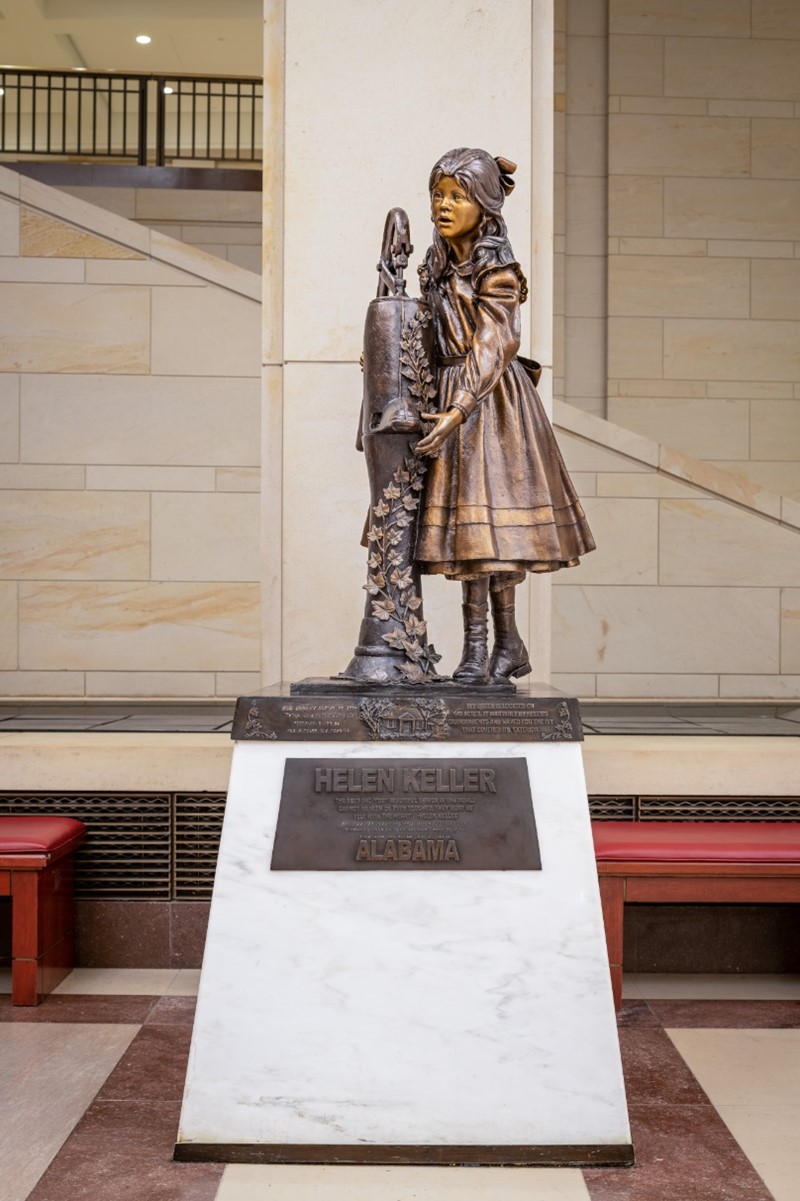
Read the Acceptance of Statute of Helen Keller Presented by the People of Alabama in the Congressional Record.
The Helen Keller National Center for Deaf-Blind Youths and Adults, established in 1967 by an act of Congress, provides services to promote the quality of life for deaf-blind individuals. The headquarters is located in Sands Point, New York, and they have locations throughout the United States. The center provides comprehensive vocational rehabilitation training and assistance with job and residential placements.
Keller died in her Connecticut home on June 1, 1968, and her ashes are interred at the National Cathedral in Washington, D.C. Read more about Keller's life on the National Park Service's website, and check out the Library of Congress Research Guide "Chronicling America," which provides access to a digital collection of historic newspapers related to Helen Keller.
The Helen Keller National Center Act of 1998 provided for the operation of the Helen Keller National Center for Deaf-Blind Youths and Adults, to extend the Developmental Disabilities Assistance and Bill of Rights Act and for other purposes. Take a look at the 2003 U.S. Postal Service's Publication "Women on Stamps," which depicts Helen Keller and Anne Sullivan on a stamp issued in 1980.